If you watch th.e Amazing Race you always see the participants racing through airports, just making connections, and hopping from plane to cars, buses, or trains. Reality (no pun intended) is a little different. When you have a tight connection because of a weather delay, everything goes slowly when you arrive at the airport. We arrived at JFK/New York at 4:35 instead of 3:00. Our connection to Amsterdam departed at 6:00. As we landed we thought we could pick up our bags, go to KLM ticketing, get through security, and get to our gate for the last boarding call. This is where everything slowed down. The jetway was not ready for the plane, the full plane emptied so slowly, and they changed baggage carousels on us. Once we had our bag we waited for a train to get us to the KLM terminal. We arrived there at 5:30 and went to the first agent available. When I said we wanted to check our bags for the 6:00 flight, she said "you won't make it.". International flights need baggage an hour before the flight, and security was between us and the gate. After searching on her computer for options she suggested flying standby at 11:00 that night, and get to Amsterdam at noon Friday. The downside to that is we would miss our connection to Kilimanjaro by two hours. We opted for the overnight flight and planned to finds a place in Amsterdam to stay until the next Kili flight on .
To our surprise we were met in Amsterdam by a Rotary member from Charlotte who grew up in Amsterdam. She came early to visit family. She saw on FaceBook and emails that we were arriving late. She took us to a nearby hotel and will give us a ride to the airport in the morning. She will be climbing Kilimanjaro with the group. So everything worked out.
We spent our free afternoon walking around Amsterdam, a city of bicycles and canals. It was good to walk in the sunshine. Kilimanjaro is only an hour different from Amsterdam, so today allowed us to adjust to the time change between legs of travel. So we had a bonus day in Amsterdam!
One other note. It is ironic that a couple days before we climb Africa's highest peak, we walked around a city that has much land below sea level. Netherlands has been reclaiming land from the sea for centuries.
Internet access will dictate how frequently I can update the blog. The six day climb is Monday - Saturday. I will meet my fellow climbers tomorrow. Looking forward to seeing the mountain tomorrow.
Friday, September 7, 2012


Wednesday, September 5, 2012
Final Packing for Thursday Departure
I have packed and repacked a couple times and check and rechecked the suggested packing list for Kilimanjaro. Everything is in a large duffel bag and a carry-on backpack. The challenge has been to divide up clothing and gear for two parts of the trip. First clothing and gear for the climb. Since we will start out in warm weather and have the potential for sub-zero temperatures on summit day, many layers are needed. Next, clothes for a 4 day safari need to be packed (assuming I will not want to wear my hiking clothes on the safari). Add in travel clothes and the clothing piles up. I thinned the stack a couple times, so I think I have enough. My gear includes a sleeping bag, sleeping pad, rain gear, water bottles and Camelback, snacks, energy bars, insect repellant and sunscreen, hiking poles, and camera. It all mounts up.
Once at the hotel in Tanzania, I can repack the duffel bag the porter will carry with most of the items, and pack my daypack with water, food, rain gear, and any layers I will need for the day. Each night at camp I can use what I need from the duffel, then repack for the next day. My packed duffel weighs 25 pounds and my daypack weighs 15 pounds, most of which is water. The daypack will get lighter as I consume the 3 to 4 liters of water each day.
I am sure I will find I forgot something and will find I brought some items I won't use. That is true of any trip. I believe I can get by with what I am taking. The main thing is I have sufficient layers to keep warm while hiking and a down sleeping bag that will ward off the cold in camp at 12,000 feet.
Posts that follow will depend on Internet access in Tanzania. Just keep checking.
Thank you for words of support and prayers for me as I travel and climb Kilimanjaro. Pray for Janice while I am away.
Once at the hotel in Tanzania, I can repack the duffel bag the porter will carry with most of the items, and pack my daypack with water, food, rain gear, and any layers I will need for the day. Each night at camp I can use what I need from the duffel, then repack for the next day. My packed duffel weighs 25 pounds and my daypack weighs 15 pounds, most of which is water. The daypack will get lighter as I consume the 3 to 4 liters of water each day.
I am sure I will find I forgot something and will find I brought some items I won't use. That is true of any trip. I believe I can get by with what I am taking. The main thing is I have sufficient layers to keep warm while hiking and a down sleeping bag that will ward off the cold in camp at 12,000 feet.
Posts that follow will depend on Internet access in Tanzania. Just keep checking.
Thank you for words of support and prayers for me as I travel and climb Kilimanjaro. Pray for Janice while I am away.
Monday, September 3, 2012
Preparations for Kilimanjaro - Part 2
Physically getting ready for climbing Kilimanjaro has been a challenge. I try to hike with the Carolina Mountain Club regularly, but summertravel and being in Burlington for a couple weeks has prevented me from those weekly hikes. My friend and fellow Kili climber Rich and I have tried to fit in a few conditioning hikes, and I have gotten a few climbs in during the past two weeks. In addition to that, I try to get to the YMCA a few days a week.
Many of the Charlotte area climbers have trained at Crowders Mountain State Park. Since I have mountains close by, I have trained a little closer to home. My aim has been to do some steep climbs that match the mileage and elevation gain that I will have on Mt. Kilimanjaro. That means a gain of 3,000 feet or more over a distance of 5 - 6 miles. A couple hikes that fit the bill are:
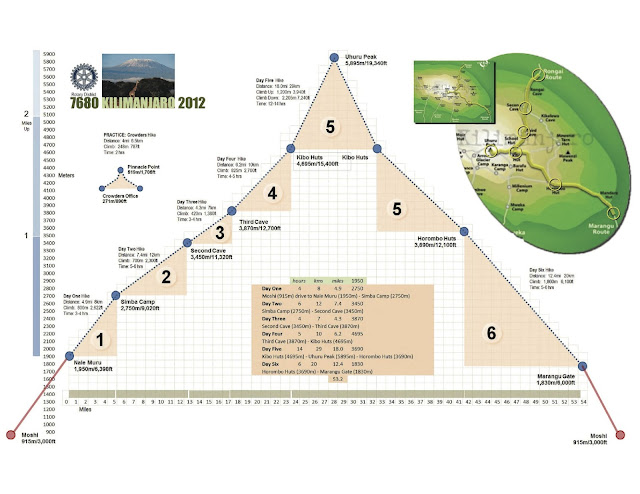
The one thing training hikes in Western North Carolina can not do is provide the higher elevations I will be hiking on Kilimanjaro. The climb is done over 6 days to allow for acclimating to increasing elevation. Days 1 - 4 cover 5 to 7 miles each day and 1,000 and 3,000 feet gain each day. Time at each camp allows the body to adapt to the higher elevation. Day 5 is the summit day with a 7,000 feet gain to the Uhuru Peak at 13,340 followed by a long descent to 12,100 feet.
Here is a graphic of the climb:
Final packing over the next two days.
Many of the Charlotte area climbers have trained at Crowders Mountain State Park. Since I have mountains close by, I have trained a little closer to home. My aim has been to do some steep climbs that match the mileage and elevation gain that I will have on Mt. Kilimanjaro. That means a gain of 3,000 feet or more over a distance of 5 - 6 miles. A couple hikes that fit the bill are:
- Mt. Cammerer in the Smokies: 3,000 feet gain over 6 miles (plus 6 mile return)
- South Mountains State Park loop: 2,800 feet gain over a total of 12 miles
- Graybeard Trail in Montreat: 2,400 feet gain over 3.7 miles (plus return)
- Black Mountain Campground to Mt. Mitchell: 3.600 feet gain over 5.8 miles (plus 5.8 mile return)
The one thing training hikes in Western North Carolina can not do is provide the higher elevations I will be hiking on Kilimanjaro. The climb is done over 6 days to allow for acclimating to increasing elevation. Days 1 - 4 cover 5 to 7 miles each day and 1,000 and 3,000 feet gain each day. Time at each camp allows the body to adapt to the higher elevation. Day 5 is the summit day with a 7,000 feet gain to the Uhuru Peak at 13,340 followed by a long descent to 12,100 feet.
Here is a graphic of the climb:

Friday, August 31, 2012
Preparations for Kilimanjaro
One week from today I will be arriving in Moshi, Tanzania and preparing to climb Mt. Kilimanjaro. I will be joining 30 other climbers from the Charlotte area on the six-day climb of the mountain. Most of the other climbers are members of Rotary clubs in the Charlotte area. These Rotarians have committed to raise $100,000 for Rotary International's "End Polio Now" campaign.
For some of us polio is a distant memory, and many others have no recollection of the disease, except for a required immunization. I remember getting the oral vaccine on a sugar cube at a local volunteer fire department when it was first developed by Dr. Albert Sabin. The fact is, polio has been eradicated from much of the world, but in some places it still poses a threat. Polio today is almost nonexistent in the Western world, but still a threat in Africa and parts of Asia.
In preparing for the trip, I consulted with the Travel office of the Buncombe County Health Department. I was advised to get all the usual vaccinations for travel to developing countries: Hepatitis A and B, typhoid, and tetanus, which I already had from my trips to Belize. New to me was a vaccination for Yellow Fever. Ironically, I was advised to get a polio booster since the disease is active in parts of Africa. A daily oral malaria pill is the only other preventive medicine I will need.
The next few days will be organizing all the clothing and gear I have laid out for the trip. I can expect temperatures from mid 80's to sub-zero. We will be trekking through a tropical rain forest, semi-arid desert, and finally an arctic-like zone at the top of the mountain.
At 19,341feet, Mt. Kilimanjaro is the tallest mountain in Africa. It is a dormant volcano in northern Tanzania only 3 degrees south of the Equator.

For some of us polio is a distant memory, and many others have no recollection of the disease, except for a required immunization. I remember getting the oral vaccine on a sugar cube at a local volunteer fire department when it was first developed by Dr. Albert Sabin. The fact is, polio has been eradicated from much of the world, but in some places it still poses a threat. Polio today is almost nonexistent in the Western world, but still a threat in Africa and parts of Asia.
In preparing for the trip, I consulted with the Travel office of the Buncombe County Health Department. I was advised to get all the usual vaccinations for travel to developing countries: Hepatitis A and B, typhoid, and tetanus, which I already had from my trips to Belize. New to me was a vaccination for Yellow Fever. Ironically, I was advised to get a polio booster since the disease is active in parts of Africa. A daily oral malaria pill is the only other preventive medicine I will need.
The next few days will be organizing all the clothing and gear I have laid out for the trip. I can expect temperatures from mid 80's to sub-zero. We will be trekking through a tropical rain forest, semi-arid desert, and finally an arctic-like zone at the top of the mountain.
At 19,341feet, Mt. Kilimanjaro is the tallest mountain in Africa. It is a dormant volcano in northern Tanzania only 3 degrees south of the Equator.

The mountain is not part of a mountain range, so it towers over 16,000 feet above the surrounding plain. This makes Kili one of the largest free-standing mountains in the world.
More details on the trip will follow on this blog.
Wednesday, April 18, 2012
The Great and the Ordinary
Every time I am in Washington, DC, I spend some time walking
at the National Mall visiting some of the memorials and monuments. Yesterday my walk took me to the Washington
Monument, still closed by the earthquake last year, the Lincoln Memorial,
Martin Luther King, Jr. Monument, the Franklin Delano Roosevelt Memorial, and
the Jefferson Memorial. I also
visited the World War II and Korean War Memorials. It was a sunny afternoon and I encountered lots of school
groups and others taking in the sights.
The monuments and memorials to the Founding Fathers, great
presidents, and champions of justice and human rights are striking in their
grand, larger-than-life scale.
Except for the Washington Monument, each has quotes and excerpts of
documents the person had written or spoken. Reading these and looking up to the statue of these great
Americans, I was struck by the fact that throughout our history, great people
have responded to the times and stepped forward to lead, to voice confidence
and to provide hope. Each of the
monuments honors a man who led at critical times: Washington and Jefferson at
the founding of the United States, Lincoln during the greatest test of our
republic, Roosevelt during the Great Depression and World War II, and King
championing civil rights for all Americans. Each led America during a time of testing. They provided leadership and articulated a vision for the country, and they provided hope for the people.
Contrasted with these individual leaders were the memorials to the wars. At the World War II Monument, the bravery of ordinary men and women is honored and memorialized. as I walked about the monument I kept thinking of my father and his service in the Pacific during the war. I saw dozens of WWII veterans, many in wheelchairs, at the memorial. I thought about the sacrifice of these brave men and the sacrifices made by women and families on the home front as well.
All this got me thinking about the challenges America faces today. We face a myriad of problems; some would argue that our problems today are as great as the ones faced in the past. Leaders came forward during those other times - Washington, Jefferson, Lincoln, Roosevelt, and King. I wonder when the next great leader will step forward. Who will lead providing a clear vision and hope for all people?
We have always had the ordinary people step forward and sacrifice for the good of the country, willing to sacrifice for the "greater good." Will we have that commitment in the future?
Perhaps every elected official in Washington DC should be required to visit the monuments and memorials at the National Mall periodically and read the inscriptions and reflect on great leadership and the sacrifices of ordinary Americans. Maybe they would remember that they are elected to serve the country.
Tuesday, September 20, 2011
A Wedding at Cana
The second chapter of John's Gospel begins with Jesus and his disciples attending a wedding in Cana. Jesus' mother was there, too. I'm not sure how big Cana was, but today the city is Kafr Kanna, an Arab city in Galilee with a population of 17,600.
In this familiar story, Jesus performs the first of seven signs, or miracles, in John's Gospel. It may seem a bit strange that the first one takes place at a wedding in a small Galilean town and doesn't involve a healing or evil spirit being cast out. In this sign, Jesus changes water into wine so the wedding feast can go on.
Interesting too, is how Jesus was brought into the situation. The wine ran out, and Jesus mother came to him and simply said, "They have no more wine." Jesus replies in a rather startling way; he addresses his mother as "Woman" or as some translations out it "Dear Woman." He goes on to say, "Why do you involve me. My time has not yet come." Undeterred, Mary tells the servants, "Do whatever he tells you."
Already in John's Gospel, Jesus has looked into the hearts of others. He looked intently at Simon when Andrew brought him to Jesus, and changed his name to Cephas - the rock. Likewise, Jesus recognized that Nathaniel was genuine, real and true. Jesus sees the hearts of everyone. This account tells us something about Mary as well. She knows her boy - even though he said it is not yet his time, she has faith that he will do something. What great instructions from Jesus mother, "Do whatever he tells you." - be obedient to Jesus.
The vessels used in the miracle are six large stoneware jars, each holding 20 or 30 gallons. These were not wine vessels, they were used to hold water for purification rites. When filled with water and then changed to wine by Jesus, they yielded 120 to 180 gallons of wine. And not just any wine, the wine steward declared the best wine of the evening. Would we expect anything less? Jesus offer us the best! The amount is significant too. Not j ust a little wine, but lots of wine! There will be more than enough, certainly more wine than can be consumed by the wedding guests. In the "Word became Flesh" prologue in John 1, verse 16 reads: For of His fullness we have all received, and grace upon grace. Not just grace, but grace upon grace - limitless grace!
Jesus used water and some stoneware jars to display His glory - the Glory of his Father. He does the same with us. In 2 Corinthians 4:7 Paul writes, But we have this treasure in jars of clay to show that this all-surpassing power is from God and not from us. We are those jars of clay - easily broken and cracked, but we have this treasure. Like the purification jars filled with water, we are filled with Living Water - the Holy Spirit. Like the water at the wedding in Cana, we too are transformed by the Holy Spirit. And it all starts with "Do whatever He tells you!"
The second chapter of John's Gospel begins with Jesus and his disciples attending a wedding in Cana. Jesus' mother was there, too. I'm not sure how big Cana was, but today the city is Kafr Kanna, an Arab city in Galilee with a population of 17,600.
In this familiar story, Jesus performs the first of seven signs, or miracles, in John's Gospel. It may seem a bit strange that the first one takes place at a wedding in a small Galilean town and doesn't involve a healing or evil spirit being cast out. In this sign, Jesus changes water into wine so the wedding feast can go on.
Interesting too, is how Jesus was brought into the situation. The wine ran out, and Jesus mother came to him and simply said, "They have no more wine." Jesus replies in a rather startling way; he addresses his mother as "Woman" or as some translations out it "Dear Woman." He goes on to say, "Why do you involve me. My time has not yet come." Undeterred, Mary tells the servants, "Do whatever he tells you."
Already in John's Gospel, Jesus has looked into the hearts of others. He looked intently at Simon when Andrew brought him to Jesus, and changed his name to Cephas - the rock. Likewise, Jesus recognized that Nathaniel was genuine, real and true. Jesus sees the hearts of everyone. This account tells us something about Mary as well. She knows her boy - even though he said it is not yet his time, she has faith that he will do something. What great instructions from Jesus mother, "Do whatever he tells you." - be obedient to Jesus.
The vessels used in the miracle are six large stoneware jars, each holding 20 or 30 gallons. These were not wine vessels, they were used to hold water for purification rites. When filled with water and then changed to wine by Jesus, they yielded 120 to 180 gallons of wine. And not just any wine, the wine steward declared the best wine of the evening. Would we expect anything less? Jesus offer us the best! The amount is significant too. Not j ust a little wine, but lots of wine! There will be more than enough, certainly more wine than can be consumed by the wedding guests. In the "Word became Flesh" prologue in John 1, verse 16 reads: For of His fullness we have all received, and grace upon grace. Not just grace, but grace upon grace - limitless grace!
Jesus used water and some stoneware jars to display His glory - the Glory of his Father. He does the same with us. In 2 Corinthians 4:7 Paul writes, But we have this treasure in jars of clay to show that this all-surpassing power is from God and not from us. We are those jars of clay - easily broken and cracked, but we have this treasure. Like the purification jars filled with water, we are filled with Living Water - the Holy Spirit. Like the water at the wedding in Cana, we too are transformed by the Holy Spirit. And it all starts with "Do whatever He tells you!"
Saturday, April 23, 2011
Easter Reflection
Christmas and Easter are high holy days in Christianity. In both popular culture and in the church, Christmas seems to get the most attention. Both have parallels, but the case can be made for Easter to have the greatest importance to Christians, because the Resurrection of Christ is the defining event in Christianity.
Christmas is preceded by four weeks of Advent, a time of anticipation for the birth of the Prince of Peace. With Christmas, we celebrate the birth of Jesus and the promise of salvation. On the night of his birth, the “multitude of the Heavenly Host” heralds Jesus coming into the world. Those who witness the birth were Mary and Joseph, a number of shepherds in the vicinity of Bethlehem, and later the Magi who came from the East. There was interest in Jesus’ birth from Herod, but only out of self-interest and protecting his rule. Later, Simeon and Anna, who were present at the Temple when Jesus was presented and named, both testified to Jesus identity as Messiah.
One wonders what became of those who witnessed Jesus’ birth and early days by the time of Jesus public ministry and the events of Holy Week. Given the life expectancy of the time, many of the the shepherds had probably died before Jesus began his ministry. The Magi had returned to their realms in the East. After Simion saw and proclaimed Jesus as Messiah he was free to “be dismissed in Peace”, and Anna the prophetess was advanced in years as well. It is presumed that Joseph had died during Jesus’ childhood. That leaves Mary, the mother of Jesus, who Scripture records as being present at Golgotha where Jesus was crucified. By the time of Jesus death, most who knew of the birth of the Prince of Peace were out of the picture.
Perhaps Christmas has grown as the popular secular and religious holiday because it focuses on birth, a new beginning and the promise of deliverance. Advent is a time of looking forward and preparing to celebrate the birth of Jesus. It is also a time of shopping and preparing for dinners and celebrations that are a part of the Christmas season.
Easter is preceded by six weeks of Lent. It is a time of introspection and reflection, beginning with Ash Wednesday and culminating with Holy Week. Lent is about sacrifice and “giving something up for Lent.” It is also a time for wandering in the wilderness, clearing spaces in one's life, and reflecting on one's spiritual journey. Holy Week services remind us of the Passion of Christ, - his betrayal, trial, punishment, and crucifixion. Perhaps we are not as comfortable with Lent as we are with Advent and Christmas because it asks us to look at ourselves as we are.
But Easter is all about victory over death. The Resurrection of Jesus is the ultimate triumph over sin. While the Nativity is all about a new hope for humanity, Easter is all about the assurance of that hope. Our promise of eternal life began with the birth of Jesus - when “the Word became flesh.” That promise became hope through the ministry of Jesus. Disciples followed Jesus and throngs of people heard about a new way to live, love and act toward one another. Jesus taught that He is “the Way, the Truth, and the Life.” That hope became our assurance with the empty tomb. We are reconciled with God through the death and resurrection of Jesus Christ.
Promise, hope, and assurance are ours through Christ.
He is Risen!
He is Risen indeed!
Subscribe to:
Posts (Atom)